
Virgin Gorda is the third largest island within the archipelago of British Virgin Islands.
Area is great for cruising as there are plenty of anchorages to choose from, and you can endlessly explore bays, beaches, little coves and islands and island-hop around. If you’re sailing around Gorda, make sure you don’t miss places such as the Baths, Savannah Bay, and the North Sound.
In the North of the island you’ll find some great diving and snorkelling. We had a plunge a few times in a short distance from the North Sound area, where we were tucked in for a few nights.
Here is a Pinnacle, Wreck and Slope dives with infos.
We did these next mentioned two dives around Virgin Gorda from 40ft monohull, in late November. Water temperature was around 28 C°, visibility around 15 metres.
The Invisibles
18°31.497’N 64°20.473’W
Anchor:
Closest over night stay spot is in the North Sound, where you can choose to moor, dock or anchor. It is a popular area. Entrance to the Sound is from the North, and you’ll find overall good protection.
For moorings, contact Leverick Bay Marina, or Bitter End Dockage. Overall holding around is good, lots of sandy patches surrounded by seaweed.
Good holding 3-7 metres depth, shelter from S, SE,SW, W and E winds, can get little rolly with Easterly breeze depending of the spot
Sail and Moor:
The Invisibles are located on the East side of Necker Island. You can sail around Necker from North or South. On the South side the channel is narrower and shallower and you’ll be making your way upwind with Easterly winds. There is a reef stretching out on the West side of the island.
There are Moorings available at the dive site. Local dive operations have the priority for these moorings, however, they are often available.
Be careful to approach the moorings and the dive site from the North, as The Invisibles leave no more than a couple of meters depth right on top of them.
This dive site is recommended only on a calm day
Dive:
Rocks formations and natural pillars forming nearly canyons in between the rocks. Swim North towards the rocks from the moorings. You’ll see the formations in 10-13 metres. You can swim around the formations, the sandy bottom slopes down to 19 metres. Surge in between the rocks and on the shallower depths can get noticeable. In between the pillars areas require good buoyancy control in tight spaces and potential surge, however, the labyrinth like canyon experience is totally worth the swim!
We saw massive groupers, barracudas, nurse shark, reef shark, eagle rays, green turtle, eels and big schools of Caribbean reef fish
The Kracken
18°29,706’N 64°24.979’W
Anchor:
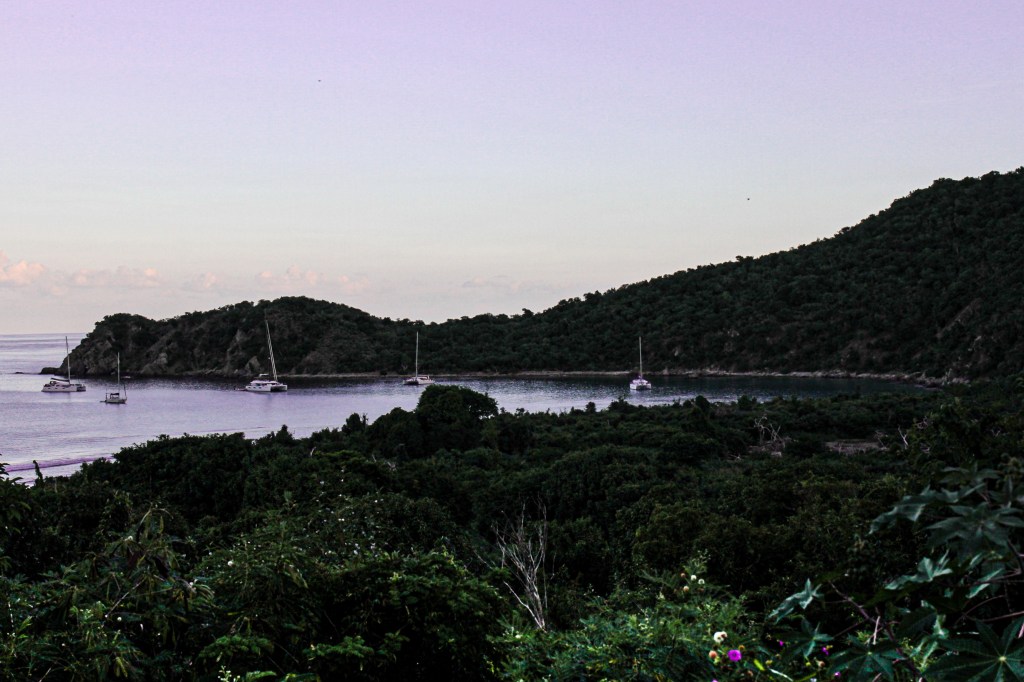
You’ll find a great anchorage just nest to the dive site and in front of the Long Beach, which personally I found the best sunset spot on Gorda overlooking the islands on the horizon. It’s a beautiful beach with the sandy, seaweed bottom, and great holding.
Anchor approx 4-6 metres depth, good holding and great shelter from N, NE, E, SE.
Dinghy and moor:
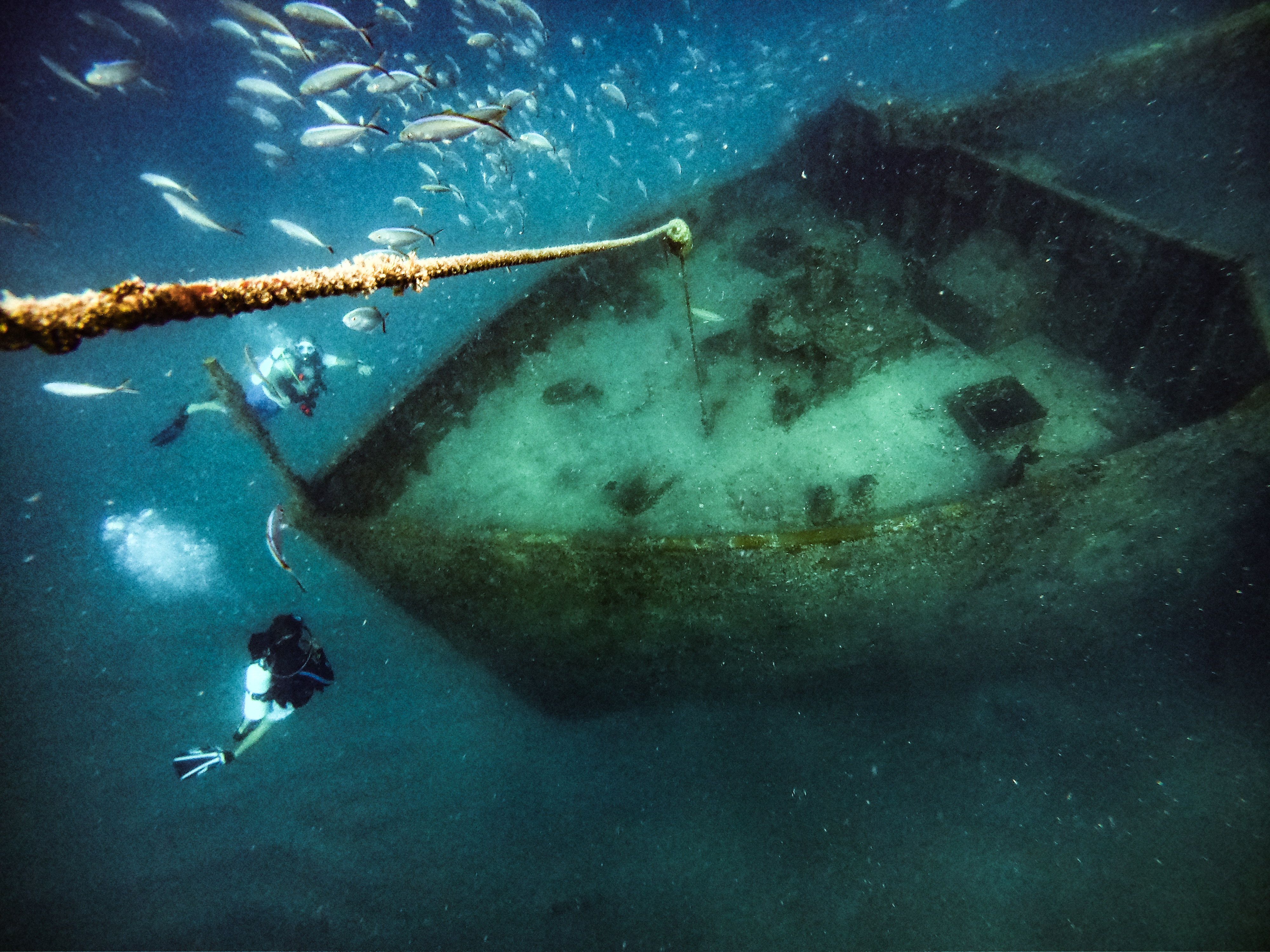
You will see dive moorings easily from the Long Beach. There are two available, the other one is attached directly to the wreck, and the other one is about 20 metres away from the wreck to the North. We took 40ft monohull and moored her, the moorings are strong and well maintained, but it is also super easy dinghy ride from the anchor.
Dive:
Dive from the moorings to 20 metres depth, around the wreck. The top of the wreck is approx 15 metres deep, so it is also a lovely free dive site. There is a sculpted Octopus in the wreck that you can try to spot, this is where the site has gotten its name!
We saw lots of Jelly fish, schools of Jacks, barracudas and nurse shark.
Kracken froom the above
Mountain Point
18°30,162’N 64°24.987’W
Anchor:
Same info as written above applies to overnight spot for Mountain point. Long Beach is just South of the point and you can easily dinghy over around the corner, also depending your dinghy, you can park in North Sound and come through thee cut between Gorda and Mosquito island.
Dinghy and moor:
You will see dive moorings easily when approaching the point. Smaller dinghies only. Not recommended with strong North wind and swell, as it wraps around the point.
Dive:
Dive from the moorings to 20 metres depth, heading to West towards the sloping wall, until you reach the sandy bottom. Follow the wall, and you will see coral heads, pinnacles, soft corals and lovely underwater scenery.
We saw lots of Jelly fish, schools of Jacks, parrot fish, and lots of different Caribbean reef fish.
 Sailing Divers